Industry Research: Damien O’Connor, Brown Bag Films

Day two of the Keyframe seminar included a talk by Damien O’Connor, a director at Brown Bag Films. He recently directed the short film Angela’s Christmas, which was broadcast on RTE over Christmas. I had emailed Damien prior to his talk and I got the chance to speak to him briefly before he gave his talk. Damien was very generous in sharing with me a little of his own path into the animation industry and recommended that I arrange a studio visit to Brown Bag. (I have subsequently arranged this and will be taking a tour of the studio on Friday the 6th of April.)


Damien also agreed to answer some questions that I had which I later emailed to him.


For you, what are the strengths of animation as a narrative medium?
You get a lot more control than live action, so you can (usually) achieve exactly what you want. The downside is the public perception that animation is for kids etc. Angela could have been live action so the medium is not all that important, other than animation allowed us to make it – this only applies to CG animation, see below re 2D


Are there any specific elements you hope to find when presented with a story idea?
Is it unique and does it hold my interest. Also always hoping there is an emotion to it – just out and out funny is fine, but poignancy is always better. Also can it be done in live action, if it is about say a bunch of teens talking, then animating it pointless.


What do you look for in the collaboration process with other writers and visual artists?
Collaborations are odd things because they are very hard to get out of if they don’t work out. A good track record is always a plus and do I like their work or do they have a GREAT idea that needs a push or guidance, if I don’t like their work then it won’t work, plain and simple. But equally if I am a fan then do they need me? People quickly lose interest in things
unless they are employed to do them, so if it is a workplace collaboration I always try to
make it work,I have never had a spec collaboration work out as people move on, get other work etc etc  


What do you think are the challenges of adapting a pre-existing story as opposed to an original ideas?
Pre-existing is easier as foundations there to build on. Original is harder as you need to
convince more people it is worth doing, pre-existing removes some of the insecurity as it is
already proven to work (someone has published it already etc).  


What is the most rewarding aspect of the process for you?
Making something people respond to, I love early stages, animatic, script etc which is v creative. Watching animation come in can be a bit of a slog to be honest as groundwork done, so now you are hoping work coming in matches what you want and fixing it if it does not.


In your talk at Keyframe you spoke about limitations and the challenge of engaging with them creatively. Do you feel that the ‘for children’ label attached to animation in western media is a limitation that is engaged with creatively?
Nope, there is a huge misconception about animation out there, festivals as guilty as anyone – they have animation strands, animation films – a film is a film, be it for kids, adults –
the medium is irrelevant. Angela’s Christmas for all ages, but it’s first public screening
was initially pitched towards kids … because animation means kids in so many peoples eyes.
I am as guilty though, it takes a lot to make me watch an animated film,my preference is live action.


How do you feel the evolution of narrative forms within animation compares with technical evolution?
The technical evolution is the only reason I am now working in animation. I hated 2D animation as it has way too many limitations (bad ones) – and it is a pain to produce. When I first moved a camera in CG I was hooked. So CG now allows us tell stories we want, no more waiting three weeks to change a BG. Having said that a foundation in 2D is hugely helpful as you carefully choose every cam move instead of throwing the camera around. But ultimately none of it matters if the the story or ability of creators not up to scratch. But the reasons there are better animated films now is because creators freer to get results. tech helps them achieve it.

Keyframe Seminar

This week Keyframe, a three day animation seminar was being held by the college in the local library. Some of the speakers who I felt were relevant to my research were;


Suzanne Blake, an animatic editor at Boulder Media. Suzanne’s talk gave me a good insight into what’s expected from a storyboard artist and the visual process of getting the work to a suitable standard for animatic editing.


Chris Dicker, head of development at Jam Media, spoke about the process of bringing a show from concept through to commissioning. His talk was rich in details relating to the story and visual development process including; when to hold strong to important creative choices; when to compromise for the better development of the show; maintaining a strong visual identity. He also shared experiences of industry showcases and pitching to commissioners. While not relevant to me personally at this point in my career, it is information to hold on to for the future.

Krystal Georgiou, a storyboard artist with Gingerbread Animation, spoke about her own process and the storyboard process as a whole in the animation industry. Having worked as a freelance storyboard artist and now being employed by a company, her talk was very informative as to the employment conditions related to storyboarding. Krystal also used examples of her own work and others work to communicate the importance of film language to communicate the emotional narrative within a film and the importance of the storyboarding phase in creating this.

Industry Research: Making Contact

To support making contact with relevant people to my research I received emails from the course tutor Kevin Lynch. I sent enquiries to; Lena Byrne, Head of Scripting at Jam Media; Damien O’Connor, a director at Brown Bag Films and I sent a general enquiry through the Boulder Media contact page.

I received a very positive reply from Lena Byrne and I have arranged a meeting with her in the Jam Media offices.

I also received a generous reply from Damien O’Connor. He is engaged to give a talk at Keyframe, an animation seminar held by the college, and asked me to say hello there and send him any questions I may have.

Backgrounds Work in Progress

Opening scene background concepts with minimal noise and halftone patterns over scanned note paper.

Climactic scene background explorations using different blending effects with a fabric texture overlay.

Same scene, this time using a granite pattern overlay. This has created a kind of star-field effect which is interesting. I also added a slight blur to the house spot for the last rough, which I think would add to any of the concepts.

Industry Research Assignment

We have been tasked with researching relevant roles within the animation industry which we might pursue on completing the degree course. My intention on beginning this course was to evaluate the possibility of switching my career from freelance illustration and art instruction to an animation position at an established studio. Taking account of my experience to date on the course I feel that the role most suited to my present skillset and career experience would be in the pre-production sector of the animation industry. More specifically I would like to focus on storyboarding and visual development.

I began my research by browsing the websites of some of the main studios operating in Ireland at this time, including Brown Bag Films, Boulder Media, Cartoon Saloon and Jam Media. Some of the sites offered a behind the scenes insight into the studios themselves. These included interviews with staff and glimpses into the production process. Referencing their jobs pages as well the most relevant positions included; storyboard revisionist from junior to senior levels; conceptual design and character design.

Further research into storyboarding revealed that a significant amount of this type of work is hired out in a freelance model.

Background Colour Tests

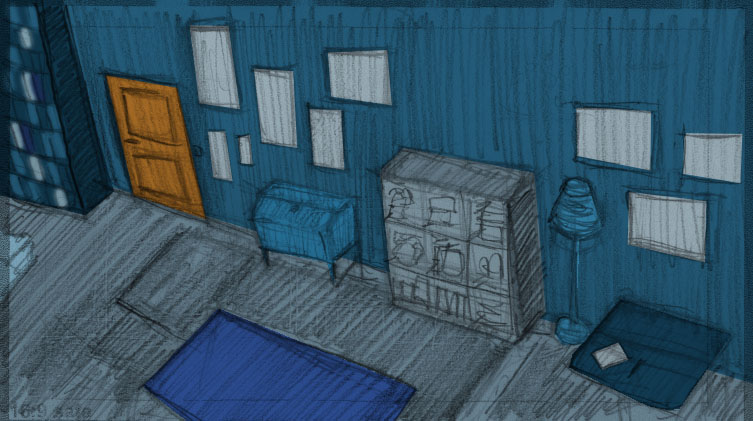
With most of the film happening in a dream space, which exists in black and white, I am curious about the idea of bringing colour into the film when the Melancholic Wife returns to the ‘unromantic walls of her real life’. I created a few colour tone tests to acclimatize to the possibility.
 Blue tones

 Yellow tones

Green tones